About
This site explores the structure of reality, life, mind, theology, and
ethical intelligence through a single guiding concern: how things hold together.
The essays and books developed here begin from an ontology of form, coherence,
participation, and persistence. They ask how reality remains intelligible across change; how
living systems maintain organized form; how mind, memory, meaning, and identity arise; how
theology can be approached without abandoning either reason or participation; and how these
questions matter for the design of future intelligent systems.
Two concepts appear throughout this project: Form and Coherence.
By Form I do not mean merely shape, appearance, or geometric structure. Form refers to the
organizing principle that makes a being the kind of being it is. It is what gives unity to a
thing's parts, powers, relations, and activities, allowing it to exist as a recognizable
whole rather than a collection of disconnected elements. Form answers the question: what is
this being?
By Coherence I do not mean logical consistency alone. Coherence refers to the manner in
which a being maintains its form through time. It is the ongoing integration of the
processes, relations, and conditions that allow a being to persist as itself despite change.
Coherence answers the question: how does this being continue to be what it is?
Form and Coherence therefore belong together. Form identifies the pattern of organization
that constitutes a being. Coherence describes the work required for that pattern to endure.
Throughout this project, questions of reality, life, mind, theology, and intelligence are
approached through these two lenses: what gives a thing its form, and what allows that form
to persist.
The project is both philosophical and practical. It develops first principles, tests them
across several domains, and asks what follows if intelligence, ethics, meaning, and agency
are not added to reality from outside, but emerge within structures of coherence.
The project
Modern thought often fragments what belongs together. Scientific
disciplines speak with different vocabularies. Philosophy and theology are treated as
separate from questions of life, mind, and technology. AI ethics is frequently approached
after the technical architecture has already been built. The result is not only
disagreement, but category confusion: concepts are moved from one domain to another without
asking whether they still mean the same thing.
This project takes a different route. It begins with ontology.
The central claim is that many debates become clearer when we ask what kind of being or
thought or process are
under discussion. What forms sustains them. What conditions allow them to persist, and what
Coherence they require. From that starting point, the essays move across five connected
fields:
Reality
Foundational essays on ontology, coherence, form, matter, energy, participation, and the
structure of being.
Life
Essays on evolution, biological form, persistence, constraint, adaptation, and coherence in
living systems.
Mind
Essays on meaning, memory, selfhood, perception, consciousness, language, and the conditions
of intelligibility.
Theology
Essays on human development, participation, divine-human relation, theological
interpretation, and recurring questions at the boundary of faith and reason.
Ethical Embodied AGI
Applied notes on embodied intelligence, ethical agency, memory, meaning, legal frameworks,
system design, and implementation.
These areas are not treated as separate projects. They are applications of a shared
framework. The aim is not to reduce life, mind, theology, or technology to one master
concept, but to make their differences intelligible within a common ontology.
Vision
The long-term vision of this project is to recover a way of thinking in which reality is not
treated as a collection of disconnected mechanisms, and intelligence is not reduced to
prediction, optimization, or output.
The questions raised here are not abstract in the weak sense. They shape how we understand
evolution, human identity, moral responsibility, theology, and artificial intelligence. They
affect how we build institutions, design systems, interpret meaning, and judge what counts
as flourishing.
The project envisions a public conversation in which science, philosophy, theology, and
technology can meet without collapsing into one another. Science should not be dismissed for
the sake of theology. Theology should not be flattened into psychology or culture. Mind
should not be reduced to computation. Ethics should not be attached to systems after the
fact.
The goal is a more coherent account of reality and a more responsible way of acting within
it.
Mission
The mission of this project is to develop and apply a Coherence
ontology across reality, life, mind, theology, and artificial intelligence.
That work has three parts.
First, to clarify first principles: Form, Coherence, persistence, participation, agency,
memory, meaning, and responsibility.
Second, to test those principles across domains where confusion is common: evolution and
purpose, consciousness and embodiment, theology and reason, ethics and intelligent
systems.
Third, to develop thought experiments, domain applications, and practical implementations
through which those principles can be tested.
Philosophical systems are often evaluated indirectly. Their consequences emerge slowly
through culture, institutions, law, education, and political life. It can take decades or
centuries before the practical implications of a theory of mind, identity, meaning, or
agency become fully visible.
Ethical Embodied AGI provides a different kind of test. By attempting to design intelligent
systems, we are forced to make explicit assumptions about what intelligence is, what memory
is, what identity is, what meaning is, and what ethical action requires. Concepts that often
remain abstract in philosophical debate become engineering constraints, architectural
decisions, and observable system behaviors.
For this reason, Ethical Embodied AGI functions as a mirror for the broader ontology
developed on this site. It allows philosophical claims to be examined under conditions where
their consequences become visible much sooner. The goal is not merely to apply a theory to
technology, but to discover whether the theory remains coherent when translated into
practice.
The laboratory therefore serves a dual purpose. It explores how future intelligent systems
might be designed responsibly, while also providing a rigorous environment in which the
underlying ontology can be challenged, refined, and tested.
This site is therefore a place for philosophical construction, public testing, and applied
reflection. It begins with ontology, but it does not remain there. It follows Form and
Coherence wherever they appear: in matter, life, thought, faith, politics, and technology.
SHARE ON
-
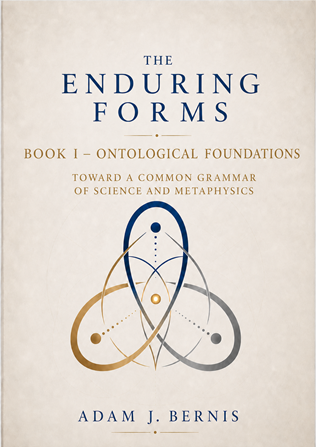
The Enduring Forms series.
Book I - Ontological Foundations, is a philosophical research monograph arguing that reality is best understood through the irreducible interplay of three poles: Consciousness, Form, and Matter/Energy. The coherence of this triad is used as the principle that explains persistence, intelligibility, and emergence across biology, mind, and theology.
Book II - The Grammar of Evolution, applies the same metaphysics to Evolutionary Biology. It confirms the scientific findings once heredity exists within a regime, but highlights the additional research needed to extend the theory of evolution across regimes.
Book III - The Grammar of Mind, follows the same explanatory register of Book I to show how mind, self, consciousness, and intelligence operate while the observer and observed are within the same scene of disclosure. The book does not invalidate empirical findings, in cognitive science and psychology, rather introduces a unique operational model to define meaning, agency, error, illusions and elusions, and selfhood.
Book IV - The Grammar of Theology, leverages the same concepts discussed in Books I, II, and III, to show how Christian Theological Anthropology shares the same ontological foundations when describing the first act of creation, good and evil, the fall, repentance, death, resurrection, and ascension. - Buy a copy
Featured Articles